If you've come across the word LoRaWAN in the context of smart sensors or remote monitoring, you're not alone in wondering what it actually means. This post is a plain-English introduction, and an explanation of why it's become our connectivity technology of choice at Safora.
The connectivity problem with remote perimeters
Electric fences do a remarkably good job of keeping animals in and threats out. The problem is that they tend to fail silently, and the areas they protect are often exactly the places where connectivity is worst. Remote farms. Wildlife reserves. Stretches of land where mobile signal is patchy at best and absent at worst.
WiFi doesn't reach. Cellular can't be relied on. Running cables across kilometres of fencing isn't realistic. So if you want to monitor what's happening along a fence line, you need a different kind of wireless technology. One built for distance, not speed.
That's where LoRaWAN comes in.
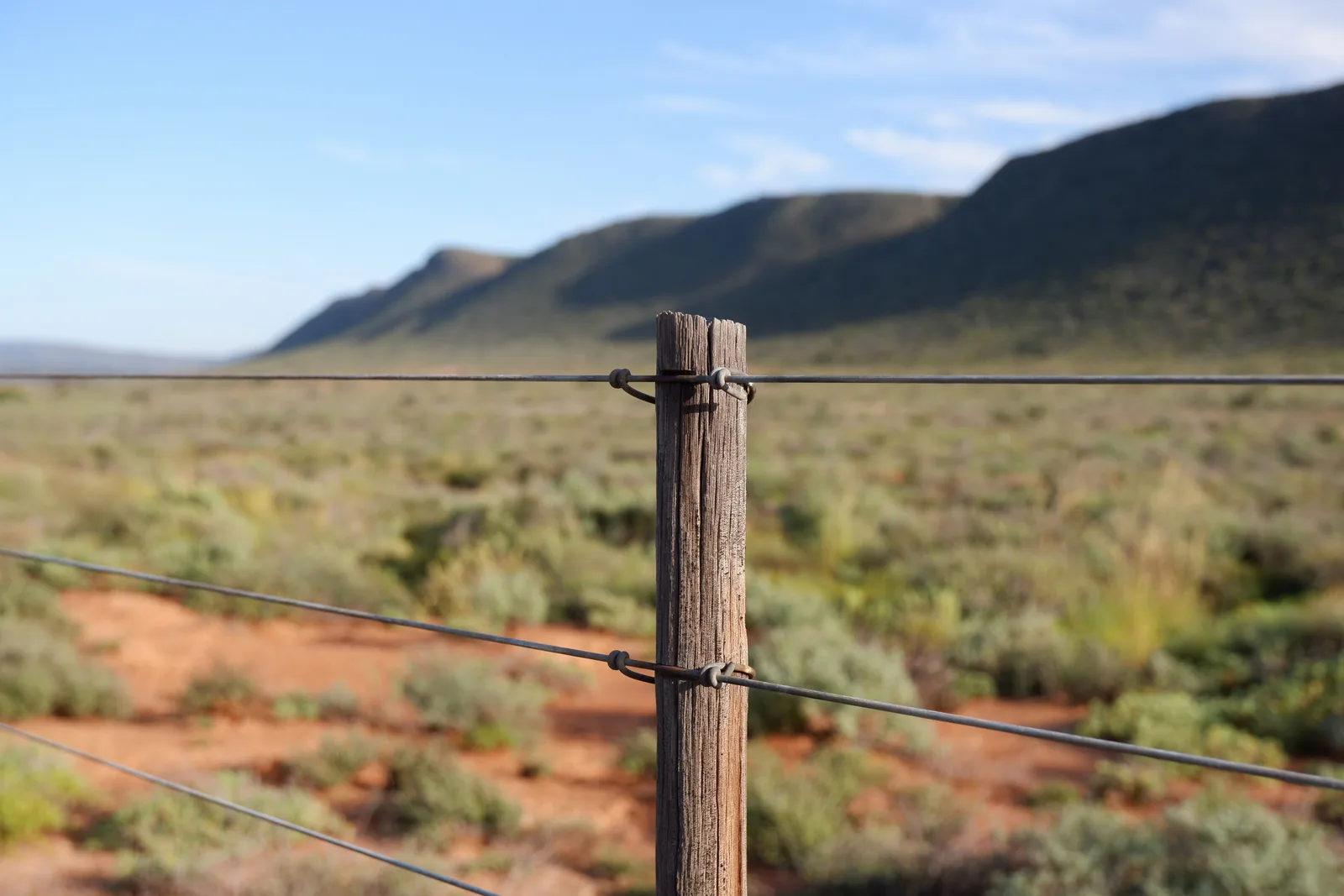
Remote perimeters are exactly where traditional connectivity falls short, and where long-range wireless starts to make sense. Photo by Juan Smith
So what is LoRaWAN?
LoRaWAN stands for Long Range Wide Area Network. It's a wireless communication protocol designed specifically for devices that need to send small amounts of data over long distances, while running on minimal power.
It's worth quickly separating two terms you'll often see together:
- LoRa is the underlying radio technology, the way signals are actually transmitted over the air. It's exceptionally good at carrying a signal across distance, even in challenging terrain.
- LoRaWAN is the network protocol built on top of that radio technology. It defines how devices communicate, how data is routed, and how security is handled across the network.
In practice, when people say "LoRaWAN," they usually mean the whole system. That's how we'll use it here.
One more thing worth knowing: LoRaWAN is an open standard, maintained by a global industry body called the LoRa Alliance. That means it's not owned by any single company, it's well-documented, widely adopted, and interoperable. Sensors from one manufacturer work alongside gateways from another. It's used across a huge range of industries, from smart agriculture to cold chain monitoring to environmental sensing. More on that in a future post.
How the network actually works
A LoRaWAN network has three basic components: sensors, gateways, and the internet.
Sensors are the devices in the field. In our case, something like the Safora Fence Shield, clipped onto a fence line. They take readings and transmit small packets of data over radio.
Gateways are the bridge between the radio world and the internet. They receive signals from sensors within their range and forward that data onward over a standard internet connection. Depending on the location, that connection might be ethernet, a SIM card, or in very remote deployments, satellite backhaul. A single gateway can serve dozens or even hundreds of sensors simultaneously, across a wide area.
The network server and application sit at the other end, receiving the data, decoding it, and making it available. In Safora's case, that means our monitoring platform and alert system.
The key point is that gateways need internet connectivity, but sensors don't. The Fence Shield only needs to be within radio range of a gateway. We'll go deeper on gateway connectivity options and how to plan coverage for a given site in a dedicated future post. In the meantime, if you're not sure what your setup needs, we're happy to advise.
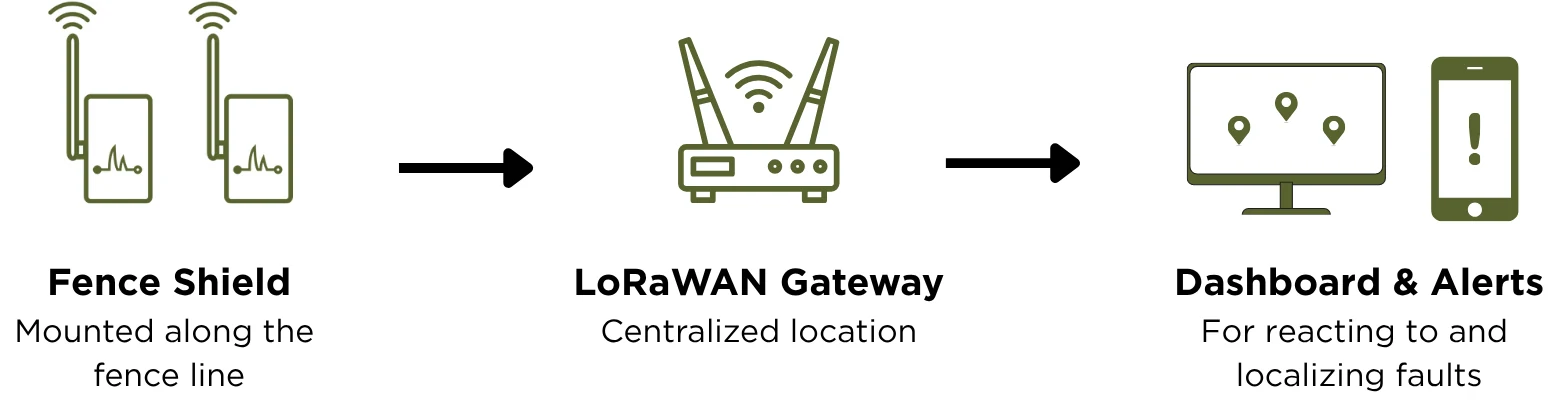
Sensors transmit over radio to a nearby gateway; the gateway forwards data to Safora's monitoring platform and alert system.
Range: what's realistic?
This is usually the first question, and the honest answer is: it depends, but the numbers are impressive.
In open, flat terrain, a single LoRaWAN gateway can reliably cover 10 kilometres or more. In areas with hills, dense vegetation, or built structures, that range reduces, but you're still typically looking at several kilometres from a well-positioned gateway.
For fence monitoring specifically, the realistic numbers matter a lot. A farm or reserve perimeter might stretch across dozens or even hundreds of kilometres. With careful gateway placement, you can cover the entire fence line without needing cellular coverage at any point along it.
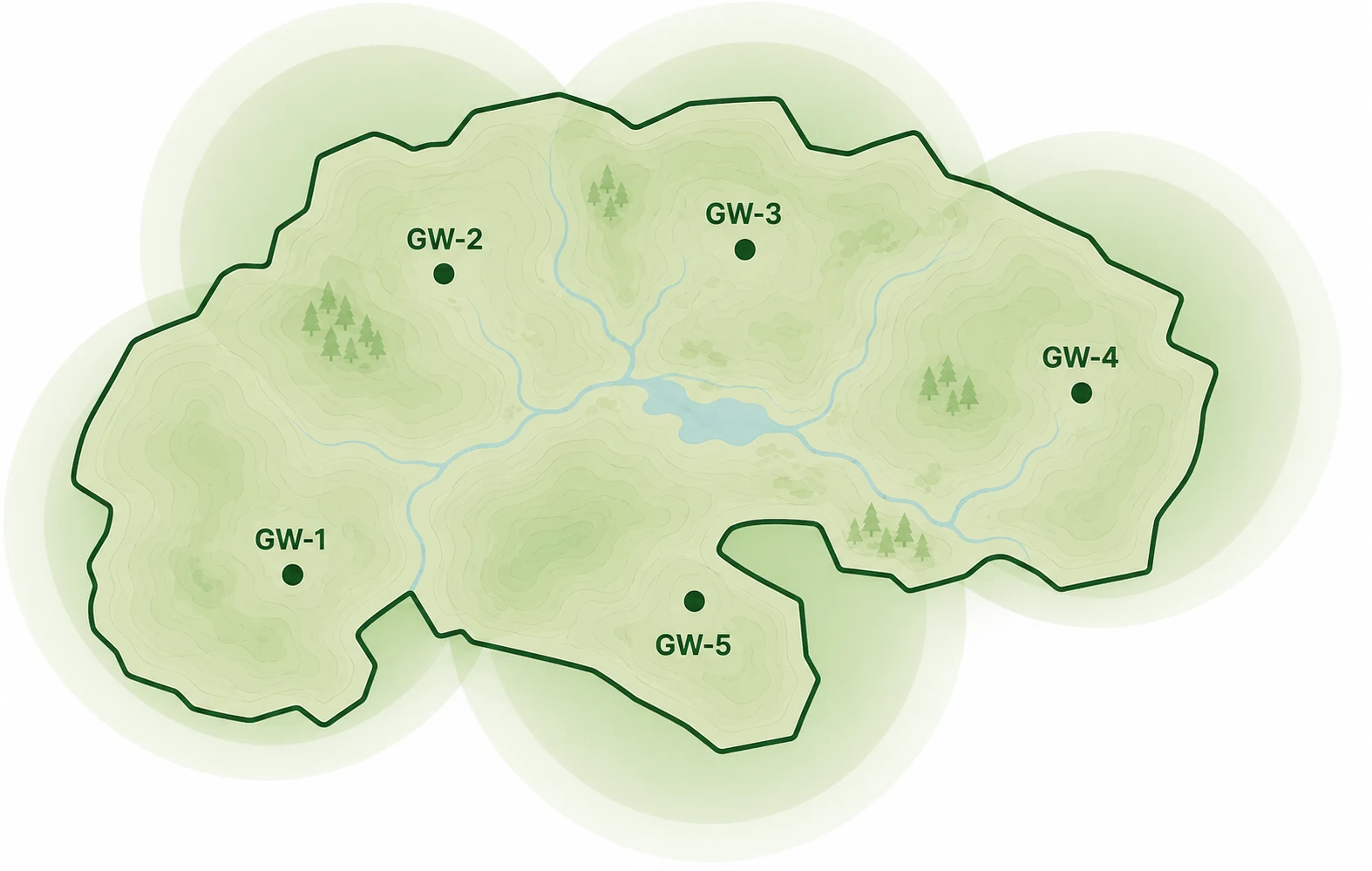
With careful placement, a handful of gateways can cover extremely large perimeters, even across varied terrain.
Why LoRaWAN is a natural fit for perimeter monitoring
Most wireless technologies are built around the assumption that you need to move a lot of data quickly. LoRaWAN makes the opposite bet: that for many real-world applications, you don't need speed, you need range, battery life, and reliability.
Fence monitoring is a perfect example. A voltage reading is a tiny piece of data. It doesn't need to arrive in milliseconds. But it does need to travel reliably from a sensor that might be kilometres from the nearest building, run for years without a battery change, and keep working through heat, rain, and dust.
LoRaWAN delivers on all of that. Sensors can run for years on a small battery, or indefinitely on solar as the Fence Shield does. The signal handles open terrain and vegetation well. And unlike cellular, there are no SIM cards, no monthly data plans, and no dependency on a mobile operator's coverage.
How Safora fits in
The Safora Fence Shield is our LoRaWAN sensor for electric fence monitoring. It clips onto your fence line, reads voltage, and sends alerts to our platform within a minute of a fault, whether that's a sudden cut or a slow voltage drop from vegetation contact.
On the network side, we supply pre-configured outdoor Safora gateways compatible with LoRaWAN, ready to deploy straight out of the box. We can also help you think through coverage for your specific site, whether that's a single farm or a large conservation area with complex terrain.
If you're wondering whether LoRaWAN is the right fit for your situation, or want to understand what a deployment would look like, feel free to reach out at info@safora-tech.com.
Once your Fence Shield is deployed and sending data over LoRaWAN, see our guide on reading fence voltage data to make sense of what it reports.
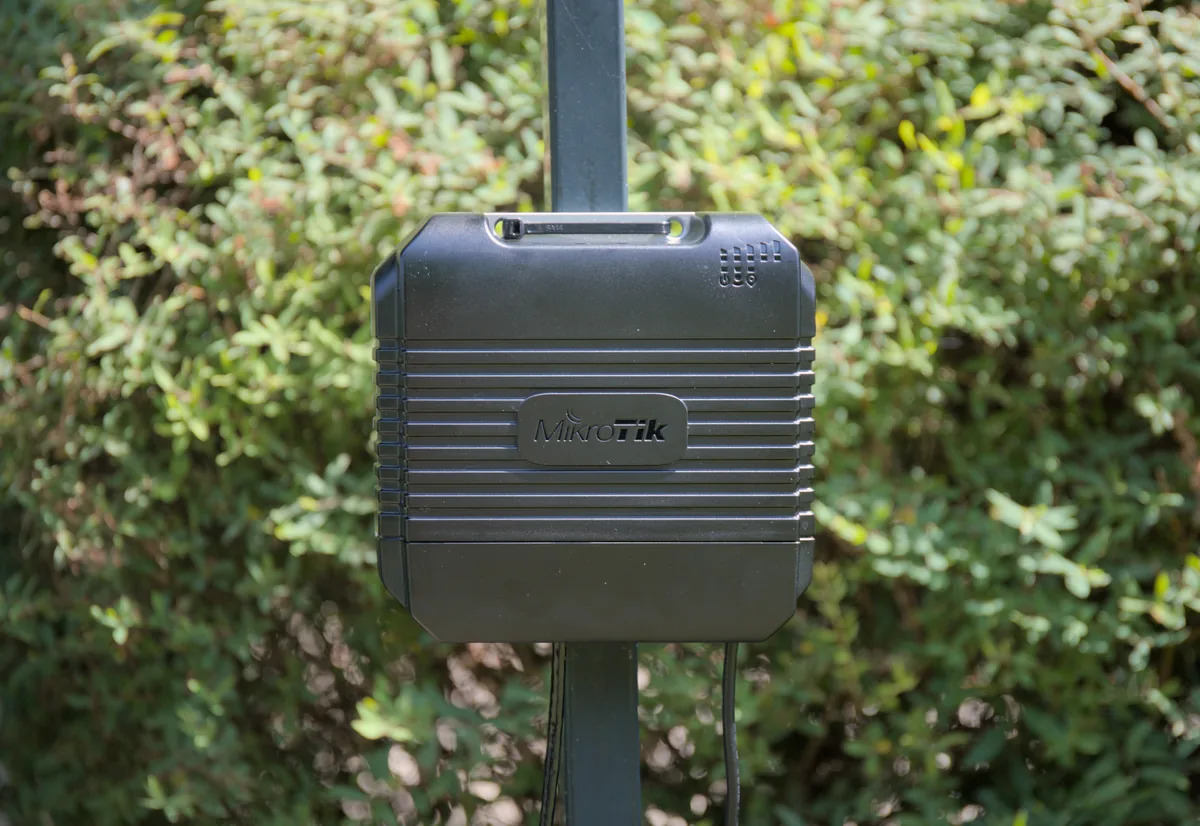
A pre-configured, outdoor LoRaWAN-compatible gateway.
Learn more about the Fence Shield or the Safora Gateway. For a more technical deep-dive on LoRaWAN, The Things Network has a great introduction to LoRaWAN article you can find here.