We've written before about why electric fences fail silently. This note is the other half of that story: once you're getting readings, what do they actually mean? A flat zero, a slow taper, a uniform dip, an oscillation, each has a distinct signature, and once you know what to look for, most faults tell you not just that something's wrong, but roughly where and why. Here's our field guide to the patterns.
What "healthy" looks like
Depending on the application, a well-earthed fence in good condition typically sits above 3-4kV. Below that, effectiveness drops off noticeably, and under roughly 1,500V a fence isn't a reliable deterrent.
A healthy line: every Fence Shield along the fence reads comfortably above 4kV, with nothing flagged.
Safora's default alert thresholds are 1,500V for alerts and 2,500V for recovery, fully configurable per line since "healthy" varies by energizer, fence length, and terrain.
Power loss: the flatline
When the energizer loses power, whether from a dead battery, a tripped breaker, or a disconnected solar panel, voltage drops to zero across every sensor on the line at once and stays there.
Power loss: every sensor on the line drops to 0V at the same time, and stays there until power is restored.
Usually, an all-sensors-zero reading points upstream, to the energizer or its power source. One exception is worth knowing, covered under short-circuits below.
Vegetation and heavy loads: the localized dip
Grass, branches, and overgrown vegetation touching a live wire bleed current to earth, pulling voltage down at and beyond the contact point without ever hitting zero. Sensors upstream typically see less effect.
A localized dip: voltage stays close to healthy near the energizer and tapers off toward the sensors nearest the vegetation contact, without reaching zero.
- Builds up over days or weeks as vegetation grows, though a storm or fast-growing weeds can drag it down faster.
- Tracks with weather. Wet grass and damp soil conduct better, so voltage often dips after rain and recovers as things dry.
- Localized: the dip sits primarily around and beyond the affected section, not spread uniformly across the entire line.
A moderate dip isn't urgent on its own. It's an early warning that the line needs clearing before things get worse.
Poor grounding: the dip everywhere
Easy to confuse with vegetation contact, since both are partial rather than total drops, but the cause and shape differ. Too few ground rods, dry or sandy soil, corroded clamps, or loosened connections weaken the return path to the energizer. Instead of a dip at one point, every sensor on the line reads lower than usual, often worse under load. A weak energizer battery can produce a very similar uniform drop, so it's worth checking alongside the ground system rather than assuming grounding by default.
Poor grounding: every sensor reads lower than usual, without any single sensor standing out as the source.
- Uniform: no single sensor stands out as worse than the rest.
- Worsens in dry conditions, since dry soil conducts poorly, the opposite of vegetation contact.
- Usually develops slowly as rods corrode or connections loosen, though a rod working loose can cause a sharper drop.
Short-circuit: the drop to zero
A live wire making direct, low-resistance contact with the ground or another wire, a fallen branch, a collapsed post, wire in wet earth, pulls voltage to zero at the point of contact.
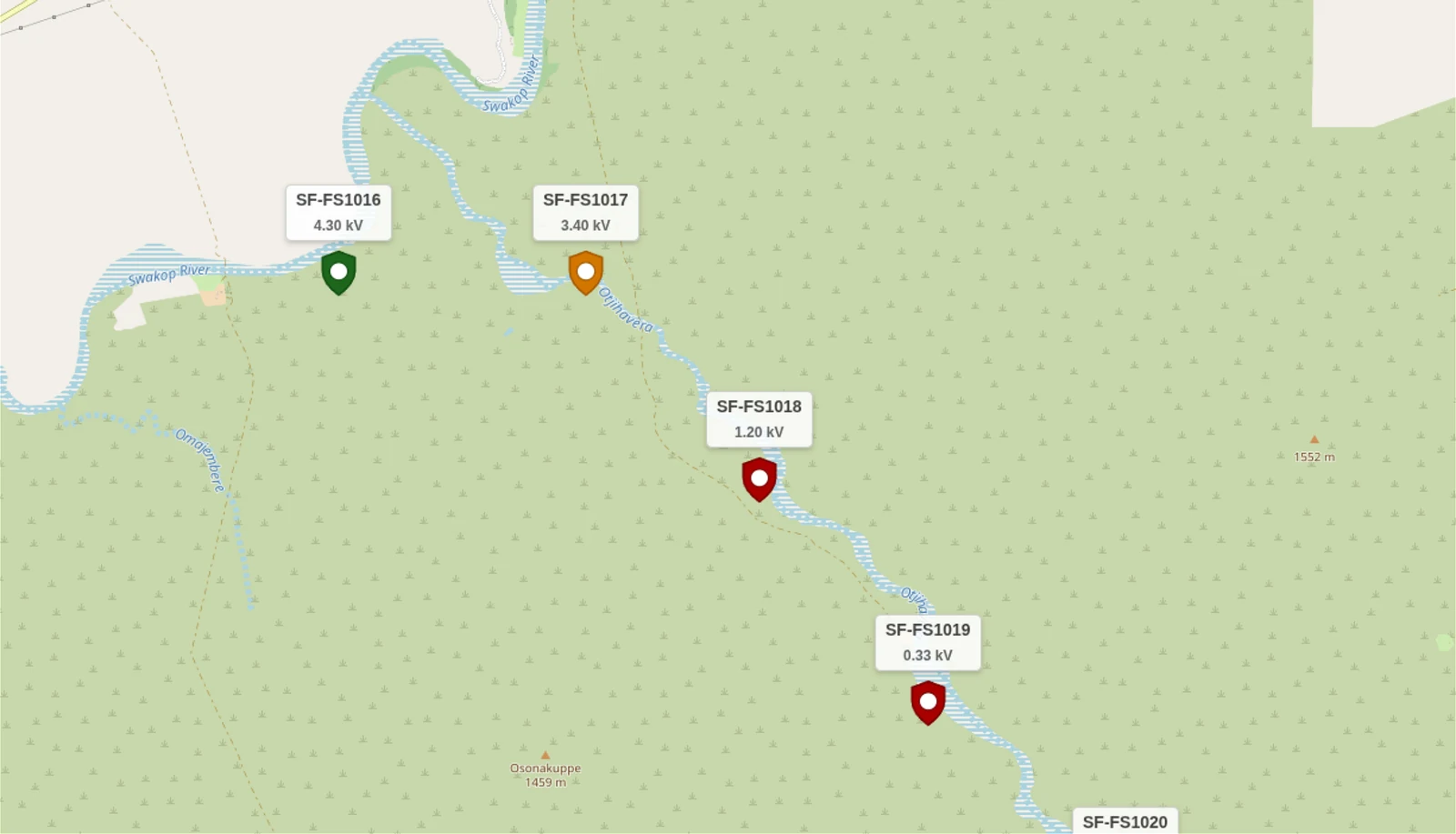
A short-circuit: voltage drops to zero between the energizer and the fault, here near SF-FS1019, and measurements shows zero voltage downstream.
Speed varies. A branch falling across the wire zeroes it almost instantly; a branch slowly settling onto the wire, or a failing insulator, can drag it down in stages.
Occasionally, a severe short (very low resistance, or close to the energizer) draws more current than the energizer can supply and pulls the whole line to zero, not just the affected segment. It seems to depend on the severity of the short, its distance from the energizer, and how much headroom the energizer has for that fence length. In practice, an all-sensors-zero reading isn't automatic proof of a power-supply fault. If the energizer checks out fine on its own, a severe short further down the line is worth ruling out too.
A note on open-circuits (wire breaks)
In theory, a clean break should read full voltage right up to the break and nothing beyond it. In the field, that clean scenario is rare: broken wire usually falls and touches the ground, a post, or another wire almost immediately, so an open-circuit typically resolves into a short-circuit reading instead, zero from the break point onward. We treat the two as the same practical case: a drop to zero at a specific point on the line. Sensor spacing tells you which stretch is affected, whether the cause turns out to be a break, a short, or both.
Energizer and battery issues: spikes, or a flat low
Voltage that repeatedly spikes up and down, rather than settling at a level or a drop, usually points to the energizer. We see this most with failing batteries on solar setups: the energizer cycles on and off, or browns out under load, as the battery struggles to keep up.
A struggling energizer or battery: voltage repeatedly spikes between a healthy level and near zero, rather than settling anywhere.
Not every energizer fault spikes. A weak battery, or an energizer undersized for the fence, can also produce a steady, uniformly low reading with no oscillation, which can look like poor grounding at first glance. If a line reads low across every sensor, check the energizer and power source alongside the ground system.
Either way, the fix is at the power source, not on the wire.
A note on fence topology
Everything above assumes a single, electrically continuous line. Many real fences are sectioned by cut-out switches, fed by separate energizers, or only connected at certain points, and a fault in one isolated sector won't show up on sensors in another, since current isn't flowing between them.
That's actually useful: sectioning makes faults easier to locate, since a drop confined to one sector tells you exactly which stretch to check. But it means sensor placement needs to match the topology. A single sensor on one sector tells you nothing about another.
If your fence is split into multiple zones, map the electrical boundaries before interpreting readings.
The same logic applies within a single sector: a higher density of Fence Shields typically narrows down a fault to a shorter stretch of wire, allowing faster and easier responses to faults.
Quick reference
| Fault | Voltage pattern | Located by |
|---|---|---|
| Power loss | Drops to 0V on all sensors at once | Simultaneous drop everywhere |
| Vegetation / heavy load | Partial dip, doesn't reach 0V | Localized to affected sensor(s) |
| Poor grounding | Partial dip, doesn't reach 0V | Uniform across every sensor on the line |
| Short-circuit | Drops to 0V at the fault point (occasionally the whole line, if severe) | Usually localized to affected sensor(s) |
| Open-circuit | In theory, high before and none after; in practice, usually resolves as a short | Localized to affected sensor(s) |
| Low battery / energizer fault | Oscillates between healthy and low, or reads uniformly low | Same pattern across the line fed by that energizer |
Turning readings into action
The Safora Fence Shield reads voltage along your fence line over LoRaWAN and flags these patterns automatically, so you're not left staring at a graph trying to work out what happened. Combined with our Platform, you get alerts within a minute of a fault, wherever it happens along the line.
If you'd like help thinking through sensor placement for your specific fence layout, including multi-zone setups, reach out at info@safora-tech.com.
Learn more about the Fence Shield or explore the Platform.